


When an auto parts website receives “please quote” without vehicle model, OE number, quantity, and destination, it is usually not a sales response problem, but rather that the catalog entry and RFQ do not retain fitment context. This article focuses on the buyer's identification path, restructuring part number search, vehicle fitment, quality evidence, and tiered inquiry so that inquiries carry preliminary judging value before they reach the sales inbox.
If inquiries are inaccurate, first check the identification path
Aftermarket purchases may start from an OE number, brand vehicle model, year or engine; wholesalers may also directly enter internal part numbers. OEM projects enter through part families, drawings and quality requirements. The website should provide multiple entry points but ultimately relate them to the same master product record, without maintaining several conflicting catalogs.
Search should tolerate spaces, hyphens and case differences, and clearly state that OE numbers are only for cross-referencing. The responsibilities of product categories and attributes can refer toMethod for managing product categories and attributes。
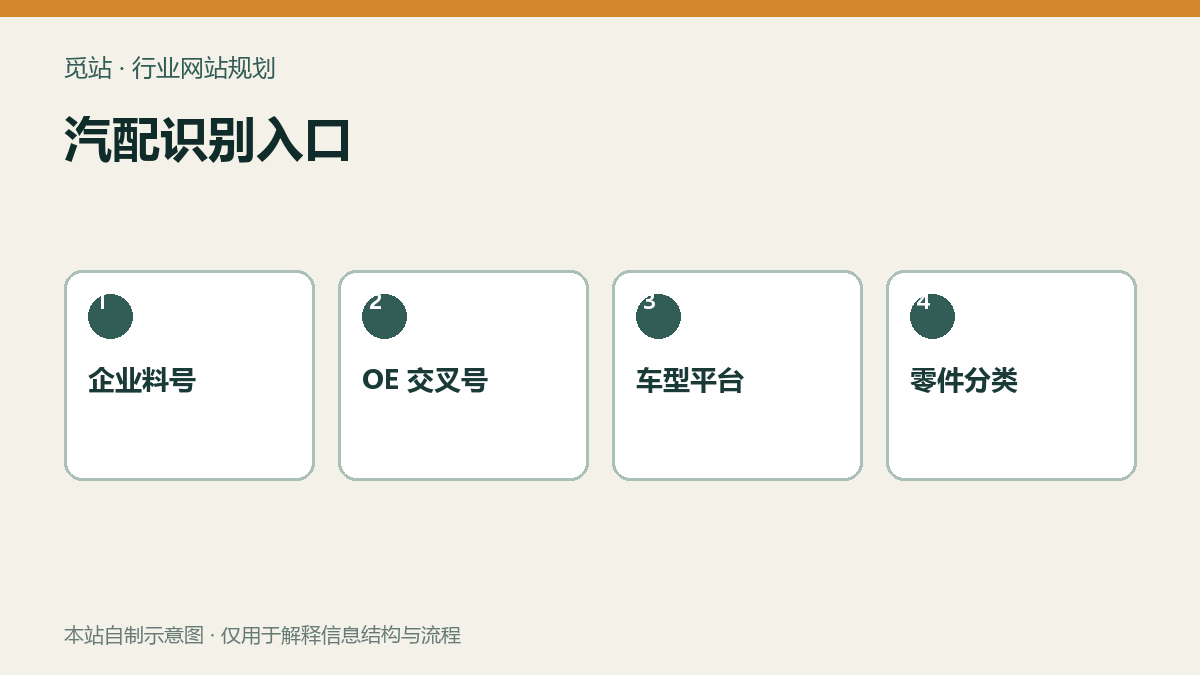
Auto parts identification entry point. Source: self-made diagram by this site, used to illustrate the information structure and flow of industry websites; no external image authorization required.
Product pages first prove fitment, then prove supply capability
The first screen displays the internal part number, OE reference numbers, key specifications, fitment summary and main image; then provides materials, dimensions, testing, packaging, MOQ, delivery time and document downloads. Quality system certificates are only the basics; specific products should also explain testing items, traceability methods and documents that can be provided.
Arrange fitment, evidence and inquiry on the same reading path, can be combined withB2B Product Detail Page Conversion GuideCheck screen by screen.
Three-tier RFQ instead of a generic contact form
- In-stock inquiry:Automatically populate the part number, selected fitment, quantity, destination and target delivery time.
- Sample request:Add project stage, testing purpose and estimated annual usage.
- Custom development:Add drawings, materials, quality documents, planned milestones and confidentiality requirements.
Each tier only displays necessary fields; after submission, save the source page and selection state; field selection can refer toKey points for B2B inquiry form design。
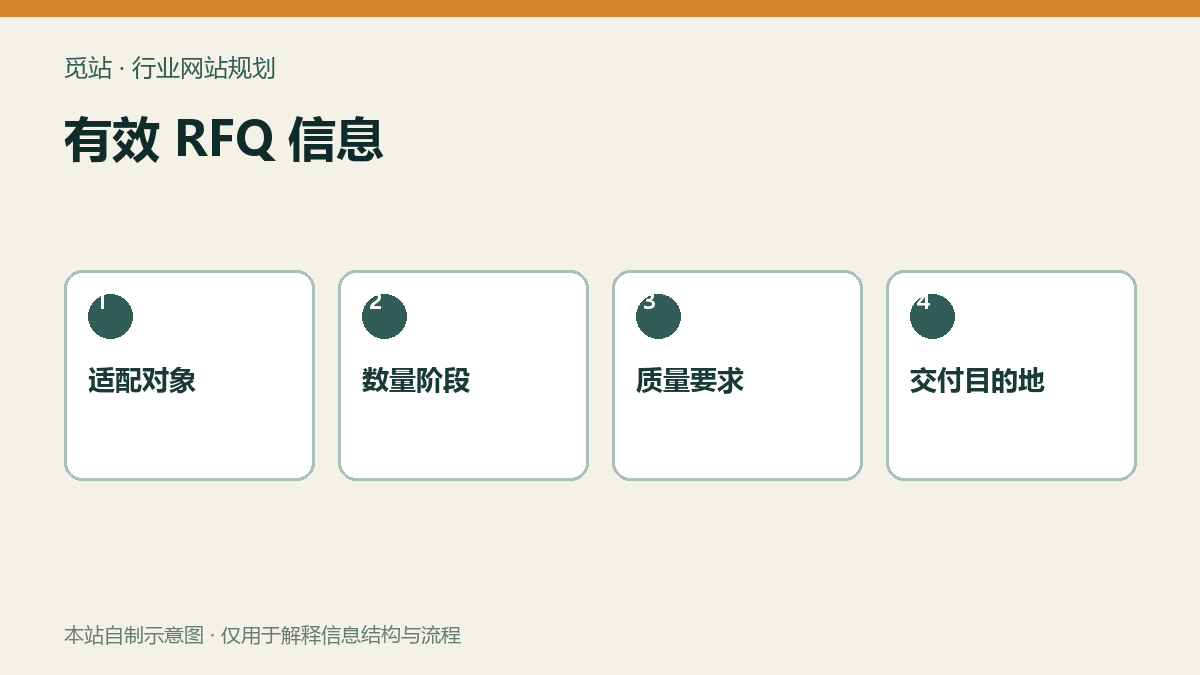
Valid RFQ information. Source: self-made schematic, used to illustrate the information structure and flow of an industry website; no external image authorization required.
Use the conversion funnel to locate missing links.
Track search, fitment selection, product view, document download, RFQ initiation, and successful submission separately, not just the final form count. If there are many searches but few product views, fix data and zero-result prompts first; if RFQ initiations are many but submissions are few, check fields, attachments, mobile experience, and error receipts. Analyze events to improve business paths; do not collect unnecessary sensitive information.
Conversion acceptance checklist.
- Whether part number search tolerates common format differences and provides zero-result suggestions.
- Whether vehicle data has a source, version, and review owner.
- Whether the OE number is clearly designated for cross-referencing purposes.
- Whether the product page simultaneously presents fitment, quality evidence, and transaction terms.
- Whether the three types of RFQ automatically carry over product and fitment context.
- Whether form errors are clear and do not cause loss of already-filled content.
Frequently asked questions
Does an auto parts website need to maintain a vehicle database?
Usually needed for aftermarket fitment business; pure OEM drawing-based projects may prioritize building part families, capability pages, and drawing RFQ.
Can the OE number serve as the unique SKU?
Not recommended. Keep the enterprise primary part number, and use OE numbers as a multi-value cross-reference field, which is easier to maintain.
Are more fields better on an inquiry form?
No. Fields should dynamically change based on ready stock, samples, and custom projects, only collecting the information needed for the current judgment.
Join the discussion
You must log in to post a comment.
After logging in, you can join the discussion. New users can register an account for free.
Do not post spam comments, advertisements, or content with malicious links. Comments must comply with relevant laws, regulations, and community guidelines.