


Antigravity Chinese is a community Chinese localization project for Antigravity IDE, suitable for developers who are already trying Google Antigravity but want to switch Agent management, settings, and common UI texts to Chinese. This article reorganizes the GitHub project content into a readable version, focusing on what problems it solves, what to check before installation, and why you cannot blindly execute community scripts as official features.
If you are interested in the practical application of AI development tools in WordPress projects, you can also continue reading ourAI development tools articles、foreign trade website building tools、WordPress development servicesandtechnical consultation portal。
What problems does this project mainly solve
According to the repository description,kdczyz/antigravity-chinese aims to provide a Simplified Chinese localization experience for Antigravity IDE, covering core web interfaces, Agent-related interfaces, settings dialogs, and common operation text. The last push time of the repository shows 2026-07-16; actual use should still refer to the current GitHub page.
The value of such tools is not in improving model capabilities, but in lowering the cost for Chinese users to understand the interface, configuration options, and Agent working states. For those just starting to try Agent-first workflows, a Chinese interface can reduce misclicks and misunderstandings.
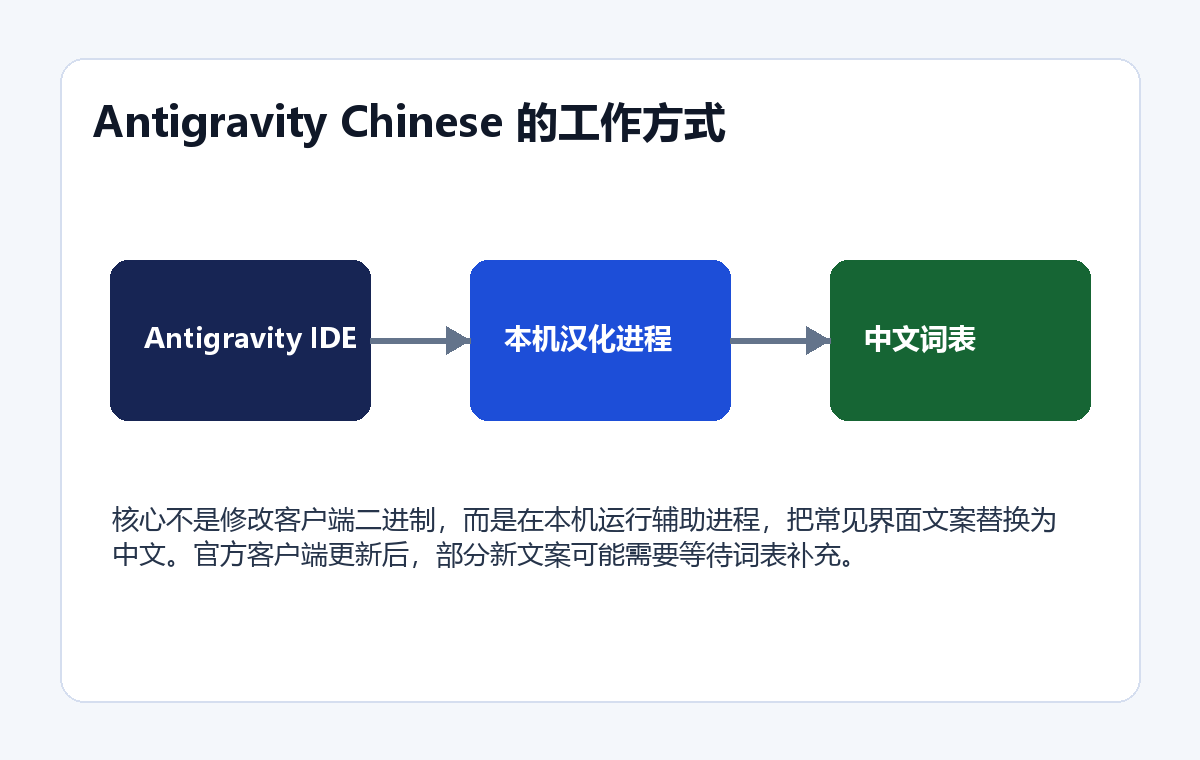
Self-made diagram from this site: Antigravity Chinese improves the interface reading experience through local processes and Chinese vocabulary lists.
How does it roughly work
The project README explicitly describes it as a local injection localization solution: a local helper process and Chinese vocabulary list replace common texts after the client web interface loads. It does not modify Antigravity client binary files, nor is it an official built-in language pack from Google.
The benefit of this mechanism is that it is relatively lightweight, can be disabled, and can be uninstalled; the cost is a strong dependency on the client interface structure. If the official client updates page structures or adds new texts, the localization coverage may temporarily be incomplete.
Do not skip these checks before installation
The basic dependencies mentioned in the repository README include the latest version of Antigravity IDE and Node.js 22 or higher. Before actually executing, you should also check the installation and uninstallation scripts in the respective directories for macOS and Windows, to confirm what background tasks will be created, what directories will be written to, and how to restore.
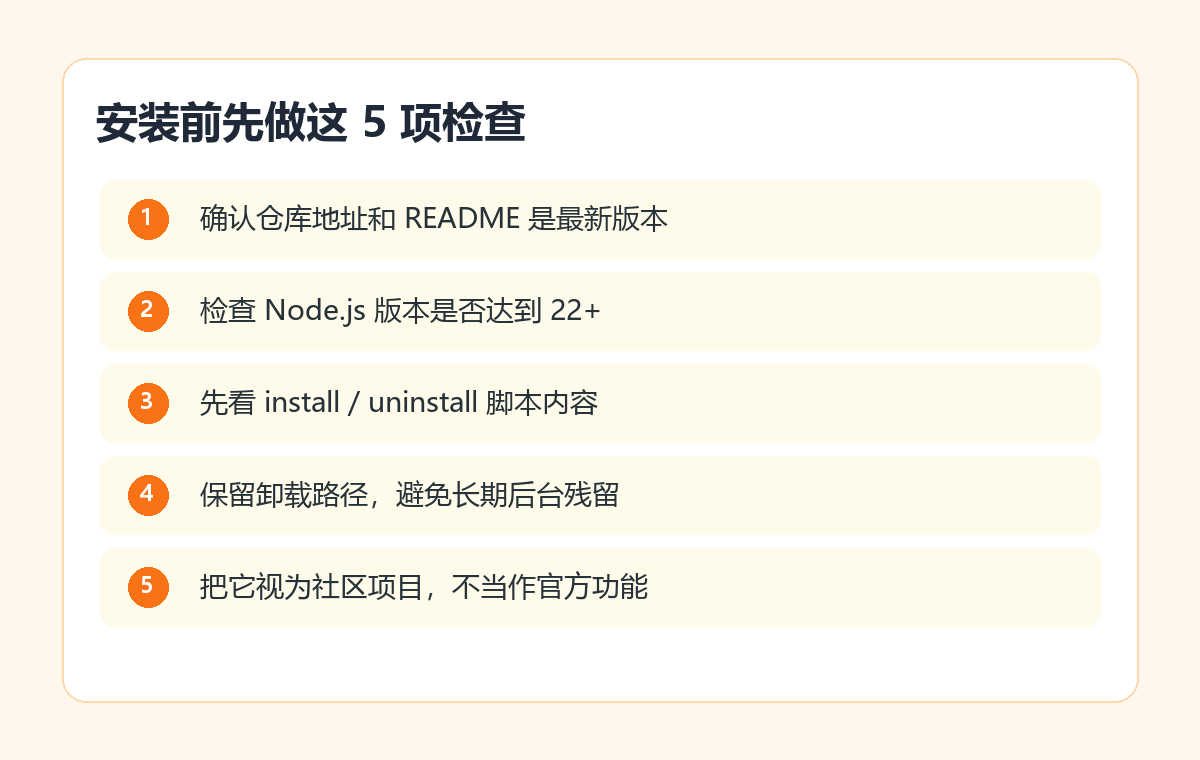
Self-made diagram from this site: Before installing the community localization project, you should check the repository, Node.js version, and uninstallation path.
Differences between macOS and Windows
The macOS directory uses shell scripts and LaunchAgent to keep the localization process running after user login; the Windows directory uses PowerShell scripts and scheduled tasks to start automatically upon system login. Both achieve the same goal, but troubleshooting methods differ.
If there is no effect after installation, do not repeatedly run it multiple times. A better sequence is: verify whether Antigravity is running, whether Node.js is available, whether the background task exists, and whether there are errors in the logs, then determine if the word list coverage is incomplete.
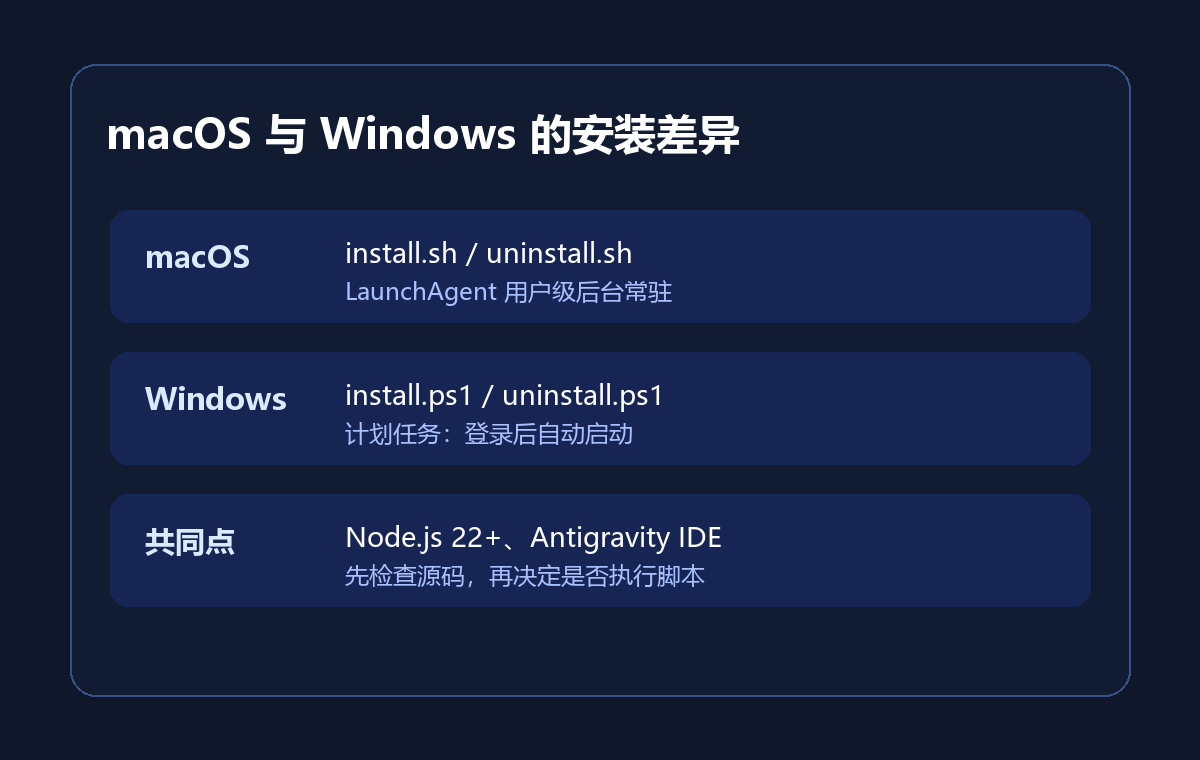
Self-made diagram from this site: macOS uses LaunchAgent, Windows uses scheduled tasks, and both need to retain an uninstall path.
Who is this suitable for?
- People who have installed Antigravity IDE but find the English interface hinders their daily use.
- People who want to quickly experience Chinese localization for Agent management, settings, and common operations.
- People who can accept the update pace of a community project and are willing to check the scripts and logs when issues occur.
- Not suitable for users who never look at the source code and are unwilling to handle uninstallation and recovery.
Risks and boundaries should be clearly stated
It is a community project, does not represent Google's official stance, and should not be packaged as an official Chinese version. You can treat it as a localization experience enhancement tool, but do not regard it as a mandatory development dependency.
In addition, the README provides a way to directly pass commands to Antigravity for execution. Although convenient, from an engineering perspective, it is more recommended to read the repository, confirm the scripts, and then execute. Any tool that creates startup or persistent background tasks should retain an uninstall path.
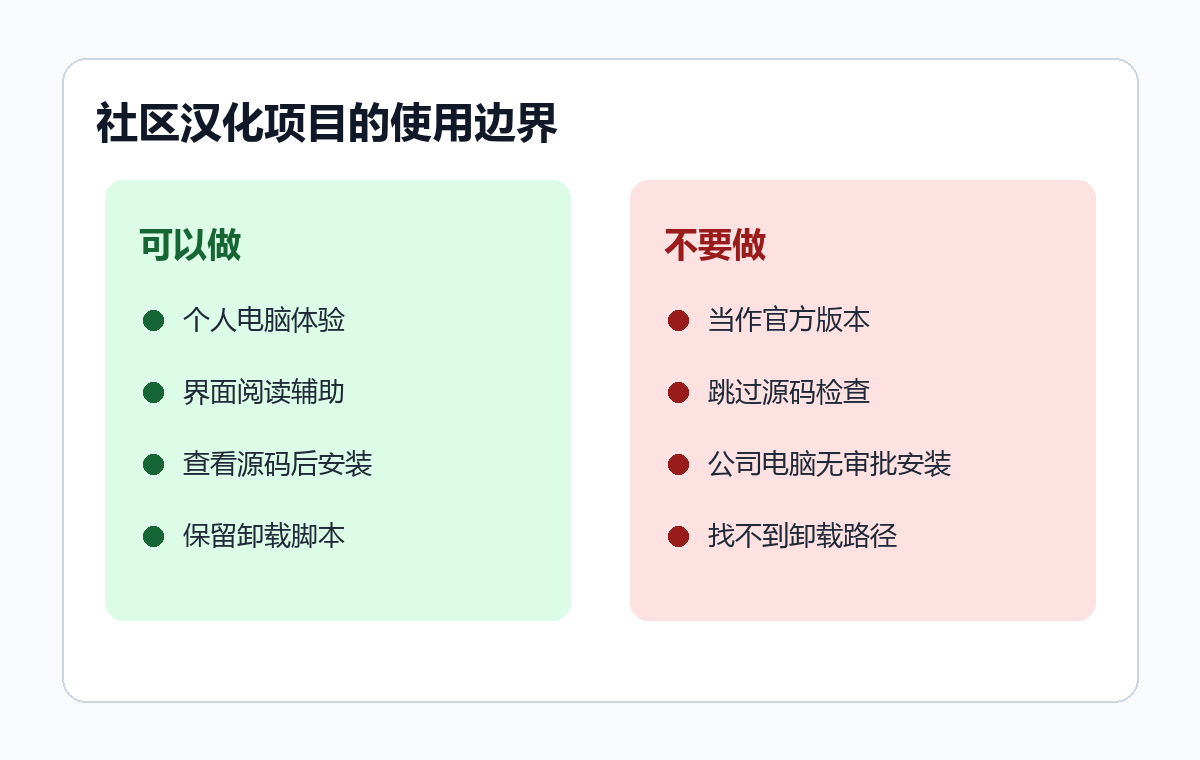
Self-made diagram from this site: The community localization project is suitable for personal experience and reading assistance, and should not be blindly installed as an official version.
Practical checklist
- Ensure the repository address is kdczyz/antigravity-chinese, and do not download modified packages from unknown cloud drives.
- Confirm that the Node.js version meets the 22+ requirement.
- Read the install and uninstall scripts before execution.
- After installation, note down the background task name for easy deactivation later.
- If the localization becomes ineffective after a client upgrade, first check if the project's Issues or README has been updated.
- If used on a company computer, first confirm whether the internal security policy allows such local injection tools.
Frequently asked questions
Is Antigravity Chinese an official Google project?
No. It is a community-organized Chinese localization project, suitable for users who want to lower the barrier of using an English interface. For matters involving compatibility, update cadence, and script behavior, the project repository and the official Antigravity client documentation should be the final reference.
Can I directly copy the instructions from the README and let the AI execute them?
It is not recommended to run scripts blindly. A more prudent approach is to first open the repository, check the install script, uninstall script, and dependency requirements, and then decide whether to let the local Agent or terminal execute them.
What to do if the Chinese localization fails after updating Antigravity IDE?
This type of localization usually relies on interface structure and vocabulary matching. After a major official client update, if the interface structure or copy changes, some English text may remain, requiring a project update or manual addition of terms.
Join the discussion
You must log in to post a comment.
After logging in, you can join the discussion. New users can register an account for free.
Do not post spam comments, advertisements, or content with malicious links. Comments must comply with relevant laws, regulations, and community guidelines.