


Packaging materials may be either small-batch stock with fixed specifications, or involve dimensions, material, thickness, printing, surface finishing, and bulk MOQ; turning all products into “Buy Now” or leaving only “Contact Us” will lose some customers. This article uses product standardization level and quotation variables to determine catalog sites, inquiry sites, and WooCommerce stores, and breaks down their respective conversion paths.
First, use quotation variables to determine the site type.
If SKU, price, inventory, and shipping rules are stable, customers can place orders directly without manual confirmation, suitable for a WooCommerce store. If only a few combinations of color, size, or packaging quantity exist, variable products can manage independent prices and inventory. If quoting depends on structural dimensions, material grammage, printing colors, plate charges, processes, quantity, and shipping method, a catalog plus structured RFQ is more suitable.
Don't simply judge by “B2B can't buy online.” Standard samples, stock consumables, and small-batch test orders can be store-based, while bulk customization still goes through inquiry; both paths can coexist. For basic store setup, refer toWooCommerce Tutorial Topic。
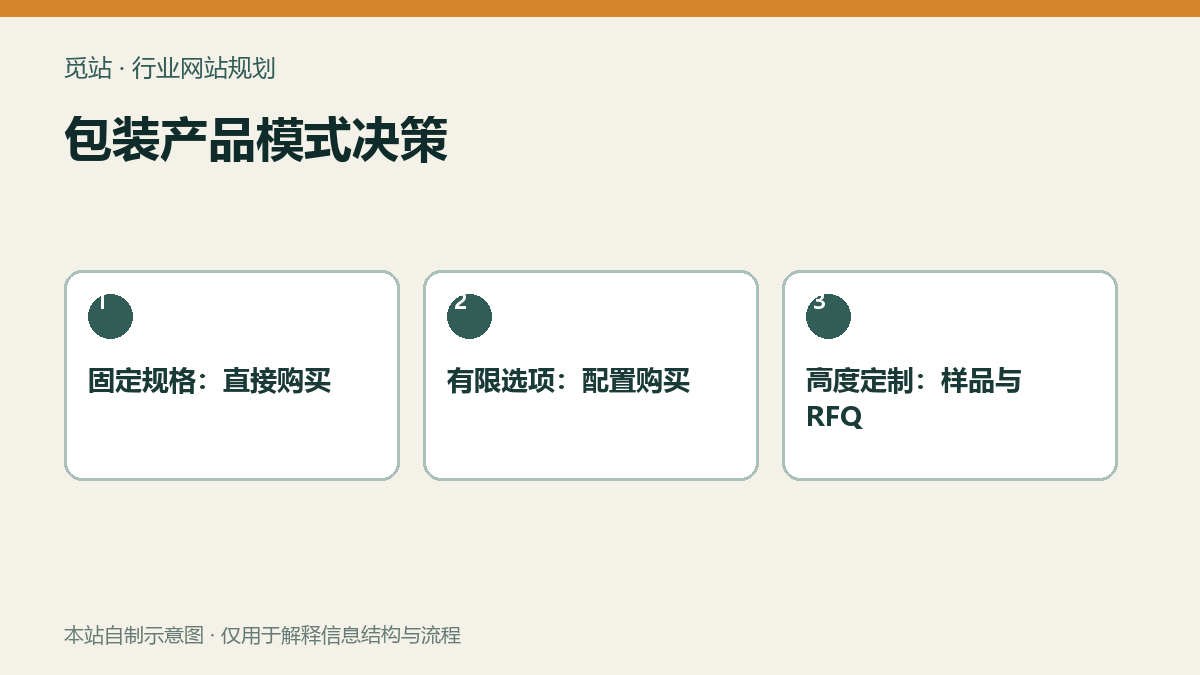
Packaging product mode decision. Source: Self-made diagram from this site, used to illustrate the information structure and process of industry websites; no external image authorization required.
Variations, add-on options, and custom inquiries are not the same thing.
WooCommerce variations are suitable for combinations that require independent SKU, price, inventory, image, or dimensions/weight. Options like foil stamping, rush processing, or notes that do not form independent stock units are more suitable as add-on options; but when there are complex dependencies between conditions or pricing must be manually calculated, it should enter a custom RFQ, rather than generating hundreds or thousands of variations.
When color, size, and material are used for filtering and also participate in variations, unify global attributes to avoid duplicate terms. For attribute setup basics, seeWooCommerce product attribute tutorial。
Use three conversion paths to cover different purchasing stages.
- Standard stock:Display tiered pricing, quantity per carton, inventory, lead time, and shipping estimate; directly add to cart.
- Samples:After selecting materials or specifications, request a sample, explaining sample fees, shipping, and bulk order deduction rules.
- Custom bulk order:Collect finished product dimensions, material, quantity, print files, destination, and target time, submit RFQ.
RFQ fields are dynamically displayed by product family, and automatically carry over the current configuration. For form simplification methods, combine withB2B inquiry form field checklist。
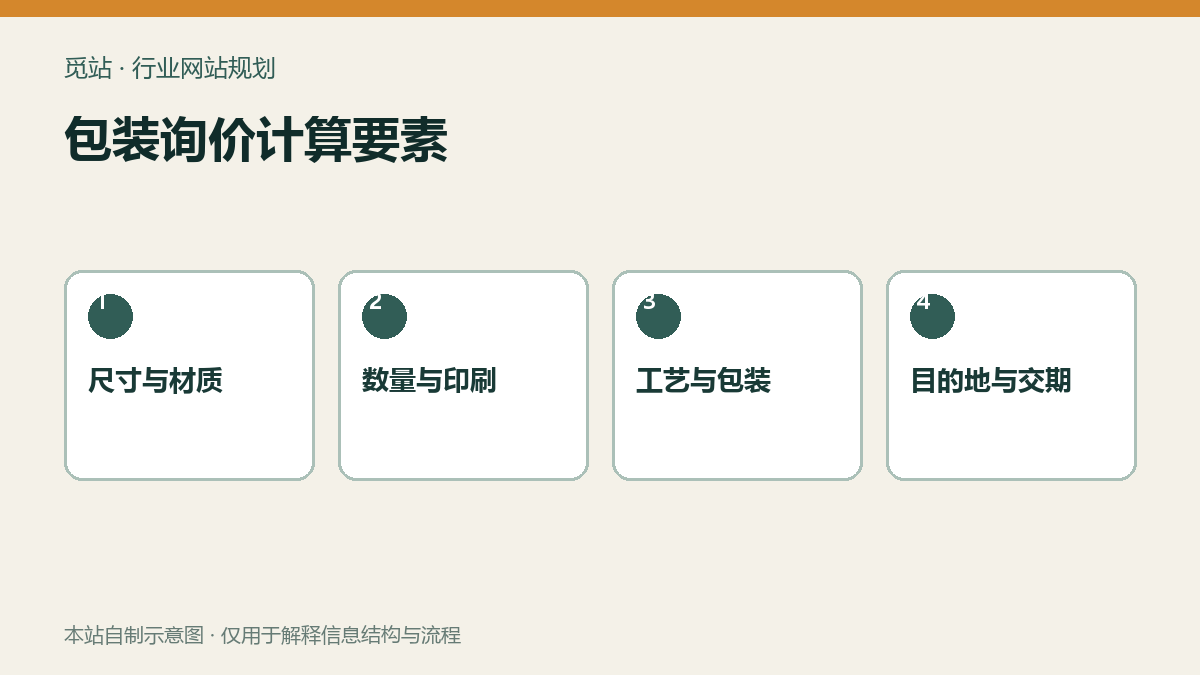
Packaging inquiry calculation factors. Source: self-made diagram from this site, used to illustrate the information structure and process of industry websites; no external image authorization required.
Product pages should explain MOQ and price changes in advance
Hiding MOQ, samples, sample lead time, and bulk production lead time in the FAQ will lead to low-quality inquiries. The product page should clearly state the MOQ for standard specifications, MOQ for customization, quantity tier ranges, which processes will increase costs, and whether shipping costs need to be confirmed separately. For eco-friendly or food-contact materials, also display the applicable scope, declarations, and downloadable test documents; do not replace evidence with vague green icons.
Conversion acceptance checklist.
- Whether each product is clearly classified as in-stock, limited configuration, or highly customized
- Whether variants are only used for combinations that require independent SKUs, pricing, or inventory
- Whether MOQ, sample fees, sampling, and bulk production lead times are near the action button
- Whether the RFQ carries over the customer's selected dimensions, material, process, and quantity
- Whether uploaded print files are restricted by format and size and stored in a controlled manner
- Whether the cart and inquiry paths avoid conflicting with each other
Frequently asked questions
Can packaging material B2B websites accept direct online payments?
Standard samples, in-stock items, or standard specification products can be sold online; highly customized bulk orders typically go through RFQ first, and a payment order is generated after confirming structure, printing, and logistics.
Is it feasible to make both size and color into variants?
Only suitable when the combination requires independent pricing, inventory, or SKU. When the combination quantity is too large or dependencies are complex, switch to filtering, additional options, or custom inquiry.
Where should MOQ be placed?
Place near the price, specifications, and main call-to-action buttons, and distinguish the different minimum order rules for standard specifications, custom printing, and samples.
Join the discussion
You must log in to post a comment.
After logging in, you can join the discussion. New users can register an account for free.
Do not post spam comments, advertisements, or content with malicious links. Comments must comply with relevant laws, regulations, and community guidelines.