


Low inquiry volumes on automation equipment websites are often not caused by button color, but by mixing standard machines, non-standard workstations, and turnkey line solutions within a single product detail page, making it impossible for visitors to confirm applicable workpieces, cycle time, interfaces, and delivery boundaries. This article starts from the purchasing decision path, restructures solutions, case studies, and RFQ, so that the information received by sales is sufficient to determine whether a project is worth pursuing.
First, separate the three types of purchasing tasks
Standard equipment buyers care about model, specifications, options, and lead time; non-standard workstation clients care about process, workpiece, cycle time, and integration interfaces; turnkey line projects also evaluate upstream and downstream equipment, data systems, site conditions, and acceptance responsibilities. Navigation can be structured with Products, Applications/Solutions, and Projects, instead of placing everything under Products.
The same equipment can be linked to multiple solution pages, but each solution page must explain the production problem and the integration approach, not simply list equipment cards again.
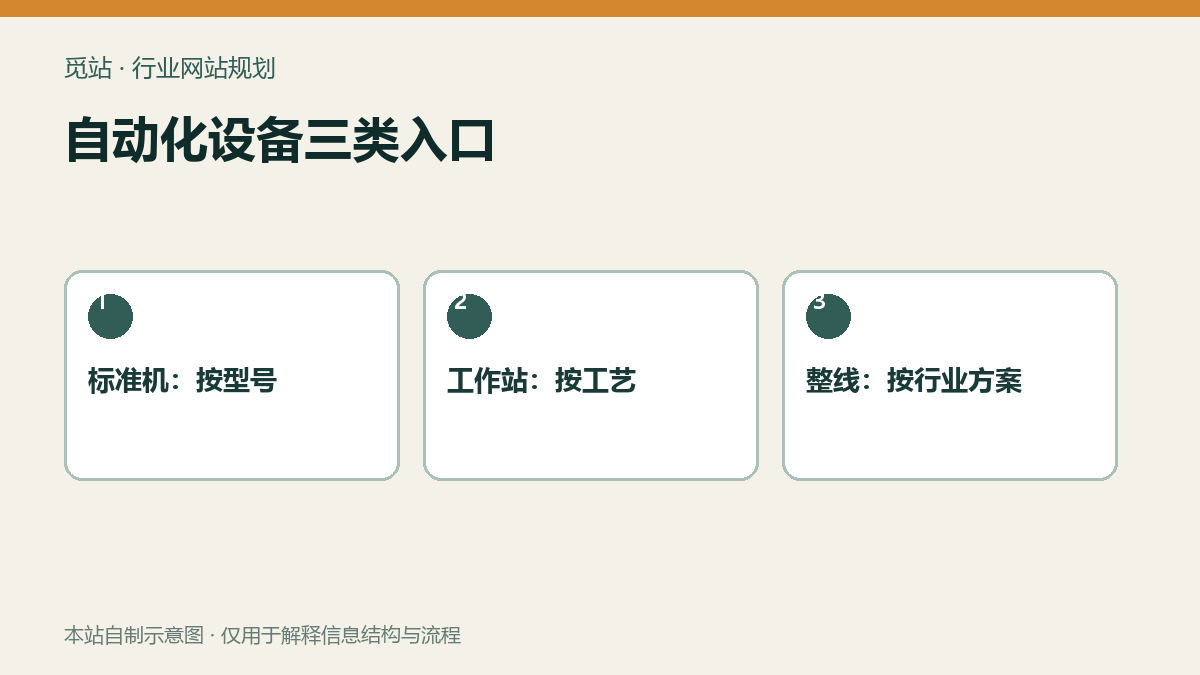
Three entry points for automation equipment. Source: self-made diagram from this site, used to illustrate the information structure and process of the industry website; no external image authorization required.
Solution pages organized by application conditions, case study pages validated by results
Solution pages are recommended to sequentially describe current process issues, input conditions, proposed architecture, key modules, interfaces, optional configurations, and project boundaries. Case study pages use anonymized and verifiable data to demonstrate before-and-after changes, such as cycle time range, changeover time, inspection coverage, or manual workstation changes. On-siteB2B product detail page methodSuitable for standard machines, while project-oriented content should also be combined withB2B case study page writing。
RFQ should not collect only name and email
- First let visitors choose standard machine, standalone workstation, or turnkey line project.
- Dynamically display fields for workpiece, cycle time, infeed/outfeed, floor space, and interfaces based on the type.
- Allow uploading layout drawings or workpiece documentation, and specify confidentiality and file restrictions.
- After submission, generate a project number and write the originating solution page and selected equipment into the backend.
- Sales record priority, responsible person, and next steps in the backend, without relying on personal email tracking.
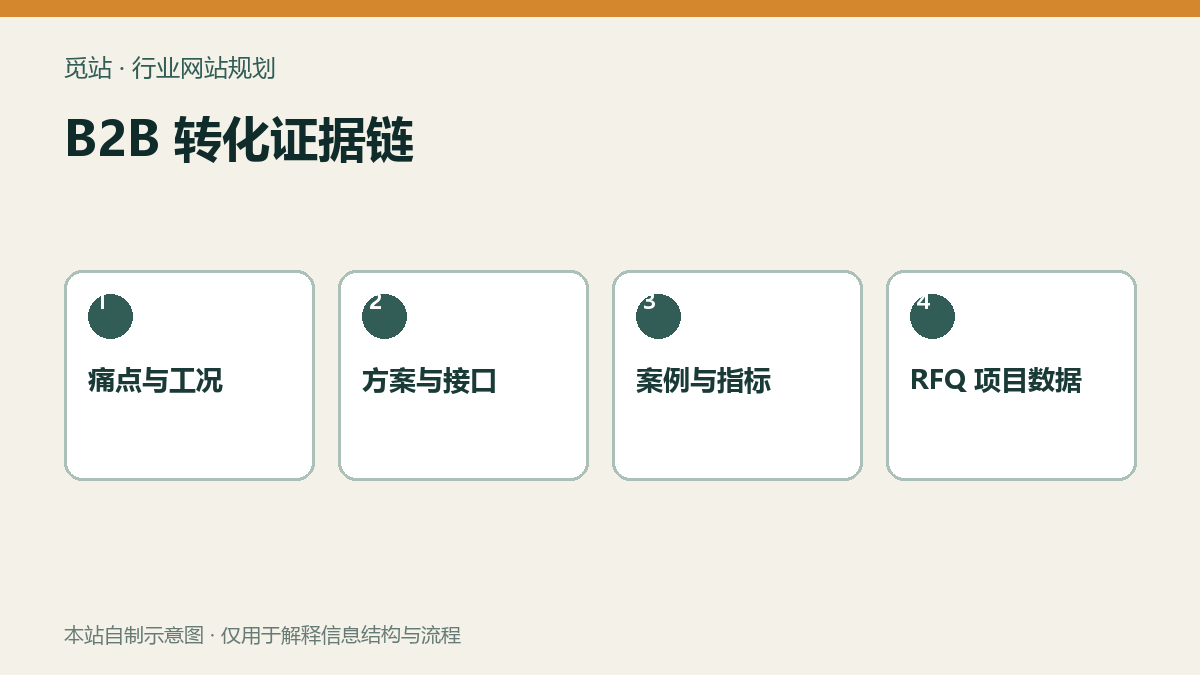
B2B conversion evidence chain. Source: self-made diagram from this site, used to illustrate the information structure and process of the industry website; no external image authorization required.
Use layered CTAs to lower the barrier for first contact
Visitors who haven't formed a project proposal can first download the selection table or view the interface list; visitors with existing needs enter the RFQ; customers who need to verify solutions schedule a technical communication. Don't let all traffic face the same long form. For the balance between field simplification and information quality, continue reading.7 Key Points for Inquiry Form Design。
Conversion acceptance checklist.
- Do standard machines, workstations, and whole-line projects have different entry points?
- Does each solution page clearly state input conditions, interfaces, and the scope of what is not included?
- Are case metrics explainable, authorized, and without overpromising?
- Does the RFQ dynamically display fields based on project type?
- Can the backend trace the source page, device, and attachments?
- Are there rules for handling form failures, duplicate submissions, and spam inquiries?
Frequently asked questions
Should the automation equipment website be categorized by industry or by equipment?
Both are needed, but with different responsibilities: equipment classification handles clear model requirements, while industry/process solutions handle problem-based needs, and the two direct traffic to each other through related modules.
Do more RFQ fields mean higher inquiry quality?
Not necessarily. For initial contact, only collect the information needed to assess the project; overly long forms will cause customers still in the research phase to drop off. Use dynamic fields for layered information collection.
Can the case only include equipment photos?
Photos only prove that the equipment exists. High-quality case studies should also explain operating conditions, solution boundaries, key interfaces, and authorized outcome metrics.
Join the discussion
You must log in to post a comment.
After logging in, you can join the discussion. New users can register an account for free.
Do not post spam comments, advertisements, or content with malicious links. Comments must comply with relevant laws, regulations, and community guidelines.