


The problem with many foreign trade websites is not a lack of products, but that the categories are structured too much like an internal ERP. Visitors cannot find a clear path after entering the site, and end up neither continuing to browse nor submitting an inquiry. This tutorial starts from the user's product-finding journey and explains how to break down, name, and present product categories on a WordPress foreign trade website so that both Google and real customers can understand them.
If you are systematically supplementing this topic, it is recommended to checkWordPress Installation Tutorial: A complete process from domain name, server to backend going live、Steps to build your own website: A complete roadmap for WordPress beginners from planning to going live、Google SEO Practical Tutorial: WordPress Foreign Trade Standalone Site from Indexing to Conversion, and go back toForeign trade website building category pageto continue organizing content on the same topic.
- WordPress Installation Tutorial: A complete process from domain name, server to backend going live
- Steps to build your own website: A complete roadmap for WordPress beginners from planning to going live
- Google SEO Practical Tutorial: WordPress Foreign Trade Standalone Site from Indexing to Conversion
- https://wordpress-code.com/category/woocommerce-jiaocheng
Step-by-step execution
- First, list the 5 to 9 core product directions that buyers most frequently ask about as candidates for first-level categories.
- Add 2 to 6 second-level categories for each main category, and avoid creating three or more levels right from the start.
- Unify category naming rules, and use terminology that the purchasing side can understand as much as possible.
- Add an introduction, application scenarios, and an inquiry entry on each category page, rather than just keeping a product grid.
First, design main categories based on how customers look for products
The categories on a foreign trade website primarily serve procurement and technical personnel, not internal company terminology. Main categories should ideally correspond directly to the common procurement entry points used by buyers, such as by product type, by application industry, or by manufacturing process, rather than moving factory department names to the front end.
If a visitor cannot figure out which category to click within 5 seconds of entering the homepage, the categorization has already failed. The number of main categories is usually more stable when controlled between 5 and 9; too few will cause confusion, and too many will make the navigation look like a cluttered catalog.
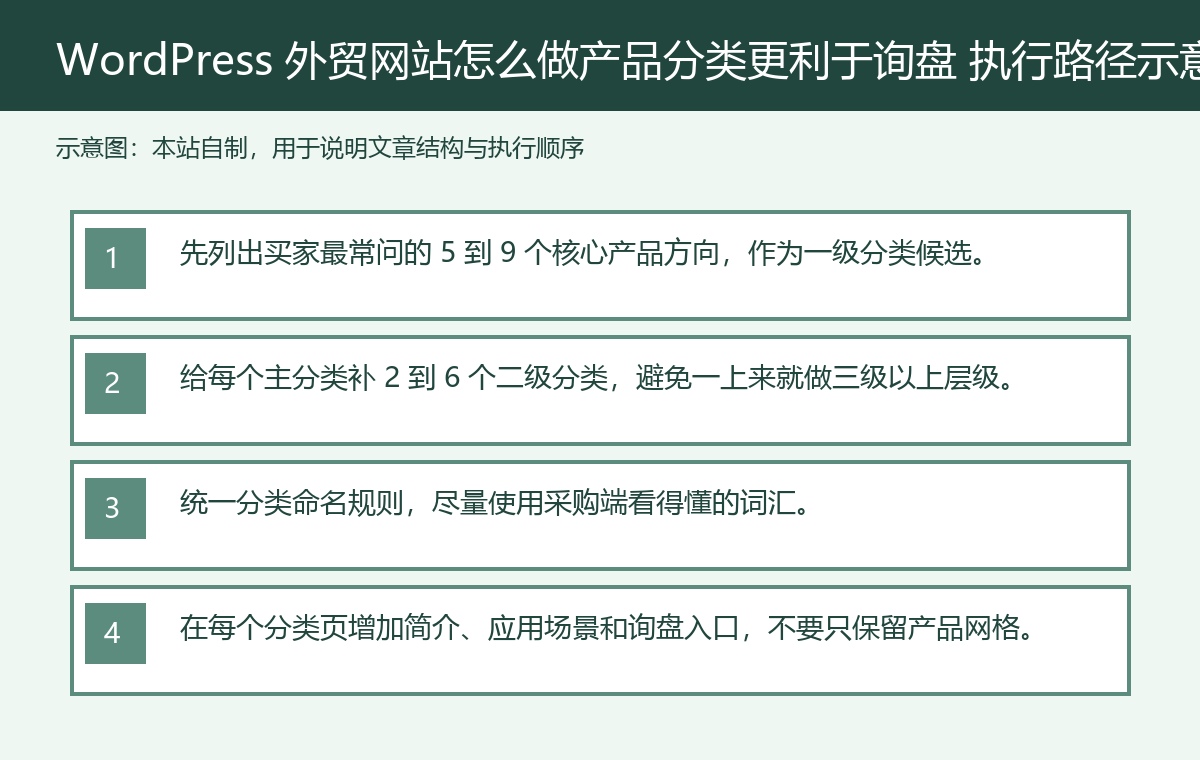
Schematic diagram: A self-made schematic diagram used to illustrate the execution logic of "How to structure product categories on a WordPress foreign trade website to better facilitate inquiries."
Use second-level categories to resolve specification differences, and do not make first-level categories too deep
First-level categories are better suited for carrying stable core product lines, while second-level categories can further subdivide by material, size, application, or industry version. This way, users first find the broad direction, then enter a more specific listing page, without being scared off by dozens of options at the first step.
If the same product belongs to multiple usage scenarios at the same time, you can place the scenarios into dedicated pages or tag pages, rather than turning every usage into a parallel main category, otherwise the site structure will quickly become repetitive.
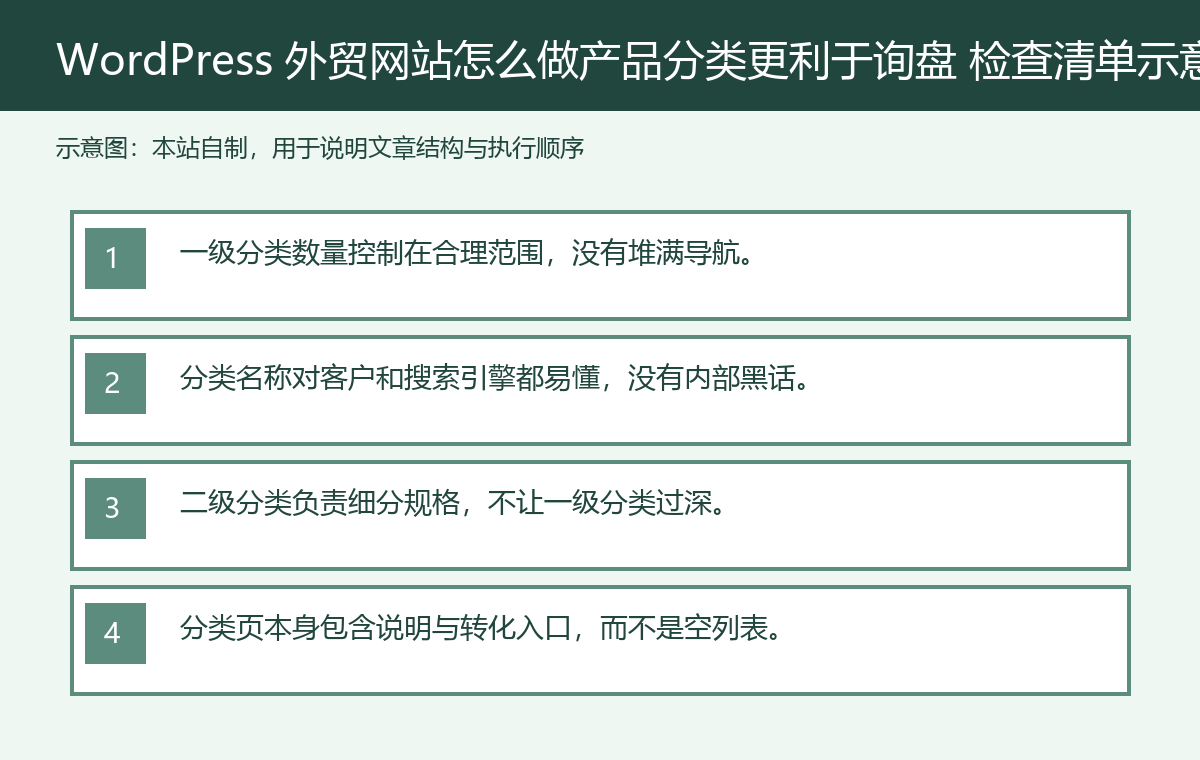
Schematic diagram: A self-made schematic diagram used to illustrate the execution logic of "How to structure product categories on a WordPress foreign trade website to better facilitate inquiries."
Category names should be able to directly match search terms and inquiry language
Do not deliberately write category titles to be abstract in order to appear professional. If they can be clearly expressed using common English product names or procurement terms, do not replace them with internal corporate terminology. This makes it easier for users to understand and also helps search engines identify the page topic more effectively.
If you run a B2B long-cycle inquiry project, the category page title, subtitle, and description should naturally include the specification ranges, application areas, and delivery capabilities that buyers care about, helping the category page itself capture long-tail traffic.
Treat category pages as inquiry entry points, not as empty list pages.
An effective category page should at least contain a category description, core product cards, FAQs, application scenarios, and a clear contact or inquiry entry point. A pure thumbnail list page makes it difficult to balance indexing and conversion at the same time.
Category pages can also link to case studies, process descriptions, and related product pages to keep users browsing. If the category structure is done well, subsequent SEO and landing page work for ads will be much easier.
Practical checklist
- The number of top-level categories is kept within a reasonable range, without overcrowding the navigation.
- Category names are easy for both customers and search engines to understand, with no internal jargon.
- Secondary categories are responsible for subdividing specifications, preventing top-level categories from becoming too deep.
- Category pages themselves contain descriptions and conversion entry points, rather than being empty lists.
- There is no substantial content duplication or path conflict between categories.
Frequently asked questions
Should foreign trade website categories be organized by industry or by product?
In most cases, organizing by product first is more reliable, because purchasing behavior usually starts with finding a product type. Industry scenarios are better supplemented with dedicated pages, filter pages, or application pages.
Is finer category hierarchy always better?
No. Layers that are too deep make it difficult for both users and crawlers to quickly understand the structure. For most foreign trade sites, maintaining two levels, with a few using three, is sufficient.
If a category page lacks substantial copy, will it affect SEO?
Yes. A pure product listing page can easily become thin content. It is recommended to supplement it with a category introduction, application notes, FAQs, and internal links.
Join the discussion
You must log in to post a comment.
After logging in, you can join the discussion. New users can register an account for free.
Do not post spam comments, advertisements, or content with malicious links. Comments must comply with relevant laws, regulations, and community guidelines.